

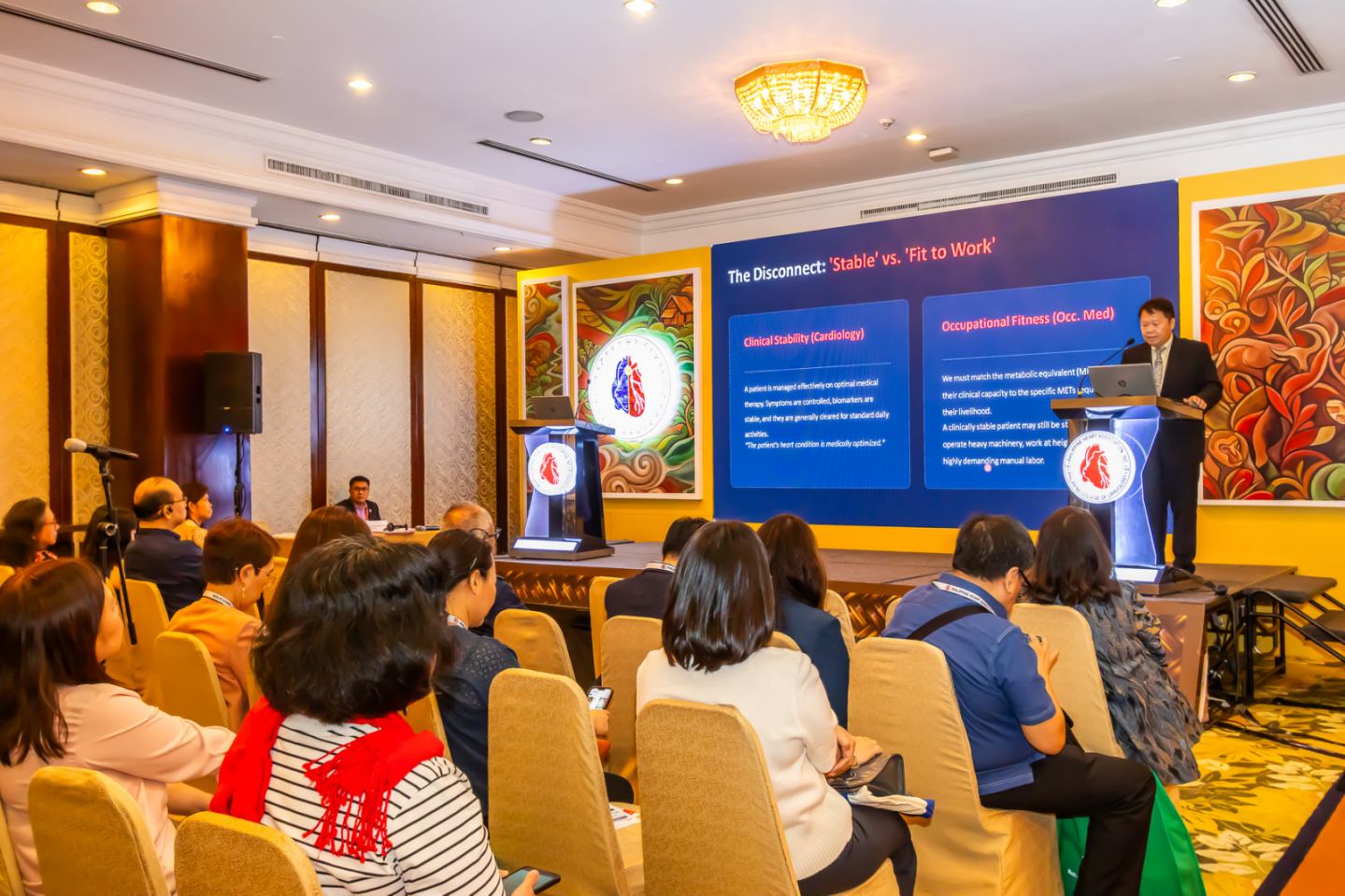
MANILA — A shift in the evaluation of cardiovascular fitness for employment is needed as traditional clinical assessments alone fail to protect workers from lethal, work-related heart conditions, an occupational medicine expert said on Wednesday, May 26, 2026.
Philippine College of Occupational Medicine Specialty Board Chair Dr. Edmyr Macabulos, speaking at a multidisciplinary session at the Philippine Heart Association (PHA) 56th Annual Convention and Scientific Meeting, explained that physicians must reframe their traditional approach to patient care by looking beyond individual symptoms to the environment producing them.
"As occupational health physicians, we often say that the patient we have is not necessarily the individual patients that we see, but more on, actually, it’s the workplace that we consider as our patient,” Macabulos said.
Nearly three million workers worldwide die annually due to work-related accidents and diseases.
This statistic, Macabulos noted, is a "persistent challenge in safeguarding the health and safety of our workers."
Data indicate that circulatory diseases, malignancy, and respiratory illnesses make up three-fourths of all work-related fatalities.
Approximately 35,000 workers lose their lives annually to work-related heart disease.
When combined with 400,000 annual stroke deaths, the toll on the global workforce becomes severe.
According to epidemiological modeling, about 10 percent to 20 percent of all cardiovascular deaths among the working-age population are directly or partially attributed to work-related stressors.
However, the data also show that 80 percent of all cardiovascular deaths are entirely preventable if modern occupational and lifestyle interventions are applied system-wide.
"An unhealthy workplace, an unsafe workplace creates chronic stress, which directly damages cardiovascular health and pushes the employees,” he said.
"It fosters risky personal habits like smoking or overeating, and this combination accelerates chronic conditions like hypertension, heart disease, and mitigating this stress is a business, critical health intervention," he added.
While clinical medicine excels at managing established diseases through precise diagnostic tools and vital therapies, occupational health serves as a branch of preventive medicine with clinical applications.
Screening early for hypertension, disseminating information about cardiovascular diseases, and improving day-to-day nutrition are needed as the workplace’s structural and physical environment of the workplace introduces unique risk factors that compound traditional clinical vulnerabilities.
These include prolonged sitting, poor diet, noise pollution, sleep deprivation from shift work disrupting circadian rhythms, and exposure to cardiotoxic chemicals like carbon monoxide or solvents.
Furthermore, psychosocial hazards—such as job insecurity, long hours, and an effort-reward imbalance where paychecks do not match life strain—create a compounding effect.
Macabulos categorized psychosocial concerns as a “silent epidemic” that often goes ignored, despite the fact that eight percent of the global burden of disease from depression is currently attributed to occupational risk.
Rethinking "fit to work" evaluations
Macabulos' presentation highlighted a critical point of friction in multidisciplinary collaboration between general cardiologists and occupational health systems: the limitation of standard diagnostic tests.
"Those tests only look at the patient in isolation," he said. "For a working individual, achieving a normal reading on a monitor is just one step. The second, more complex half of the story is translating that clinical stability into actual workplace readiness."
Experts emphasized that a patient who is clinically stable on medication and cleared from a purely cardiological standpoint is not automatically fit to resume duty, especially if their job involves operating heavy machinery, working at heights, or performing heavy physical labor.
To bridge this gap, occupational health evaluations require a continuous spectrum of care, starting from pre-employment screenings to establish a safe physiological baseline, followed by regular annual exams, and formal return-to-work evaluations after an illness.
"How do we make decisions objectively toward evaluation? It has to require detailed job hazard analysis," Macabulos concluded.
"You as the cardiologist provide us with a clear picture of the patient's functional capacity," he said.


